


Springfield Central is set to anchor a proposed 25-kilometre public transport corridor, which could reshape how residents travel across Ipswich. Linking Ipswich to Springfield Central through fast-growing suburbs like Ripley and Redbank Plains, the Ipswich to Springfield Central Public Transport Corridor is designed to deliver more than just shorter trips. It aims to transform how communities connect to jobs, education, and essential services.
Building for a Growing Population
Ipswich is one of Australia’s fastest-growing cities, with the population expected to more than double in the coming decades. Suburbs along the proposed route, including Ripley Valley, one of the nation’s largest master-planned communities, are already experiencing rapid expansion.
As more homes rise and new families settle in, the need for accessible, reliable transport becomes increasingly urgent.
Local planners say the I2S corridor is designed to meet that challenge. Spanning roughly 25 kilometres and featuring up to nine potential stations, the corridor would link Springfield Central to Ipswich Central, connecting major residential areas with employment, education, and recreational hubs.

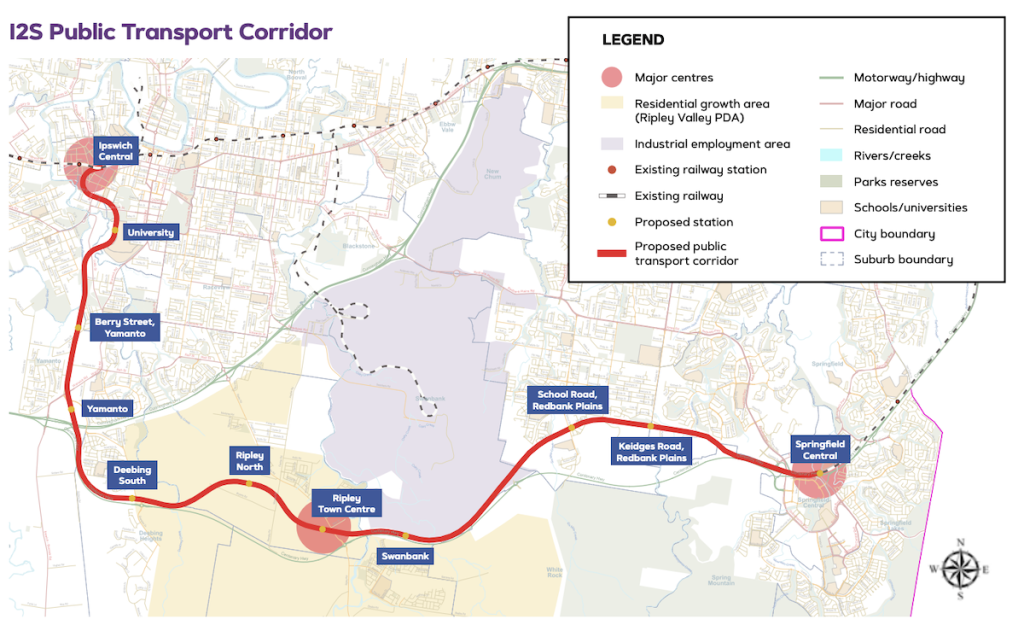
It is intended to serve more than 200,000 residents and integrate with broader transport networks, including existing train services and the Cross River Rail project in Brisbane.
The Consequences of Waiting
Without major investment in public transport, Ipswich faces a future of gridlock. Council analysis shows that by 2031, the city’s road network could fail to cope with traffic demand, causing significant delays for commuters and reducing productivity. Travelling from Ripley to Brisbane by car is projected to take longer and become more costly as congestion worsens.
The I2S corridor is seen as a solution to this looming challenge. A dedicated public transport link will reduce pressure on roads, cut travel times, and offer a viable alternative to car travel.
The corridor is also expected to encourage transit-oriented development. This planning involves building homes, shops, and services around transport hubs, creating vibrant, walkable communities.


A Community-Focused Approach
Improved connectivity means easier access to education for young people, better links to healthcare, and more options for employment. For those without cars, reliable public transport can be a lifeline, reducing isolation and opening up opportunities.
Council documents highlight the social benefits of the corridor, noting that it will help bridge the gap between new and established communities.
As Ipswich continues to expand, the corridor could play a crucial role in uniting suburbs and strengthening community ties. Local businesses could benefit from improved access for workers and customers, supporting the local economy as the region grows.
Planning the Path Ahead
Progress on the project has already begun. A strategic assessment and initial business case were completed in 2020, and the project is now listed as an early-stage proposal on Infrastructure Australia’s Infrastructure Priority List. Funding commitments have been secured for further planning, with an options analysis completed in late 2024.
The next step is the preparation of a detailed business case, which will refine the preferred alignment, costs, and delivery schedule. While the total cost is estimated at between $2 billion and $3 billion, advocates argue that the long-term economic and social benefits far outweigh the price tag.
Once complete, the corridor would form part of a wider strategy to create a sustainable, efficient transport network for South East Queensland.
Published 15-Oct-2025