




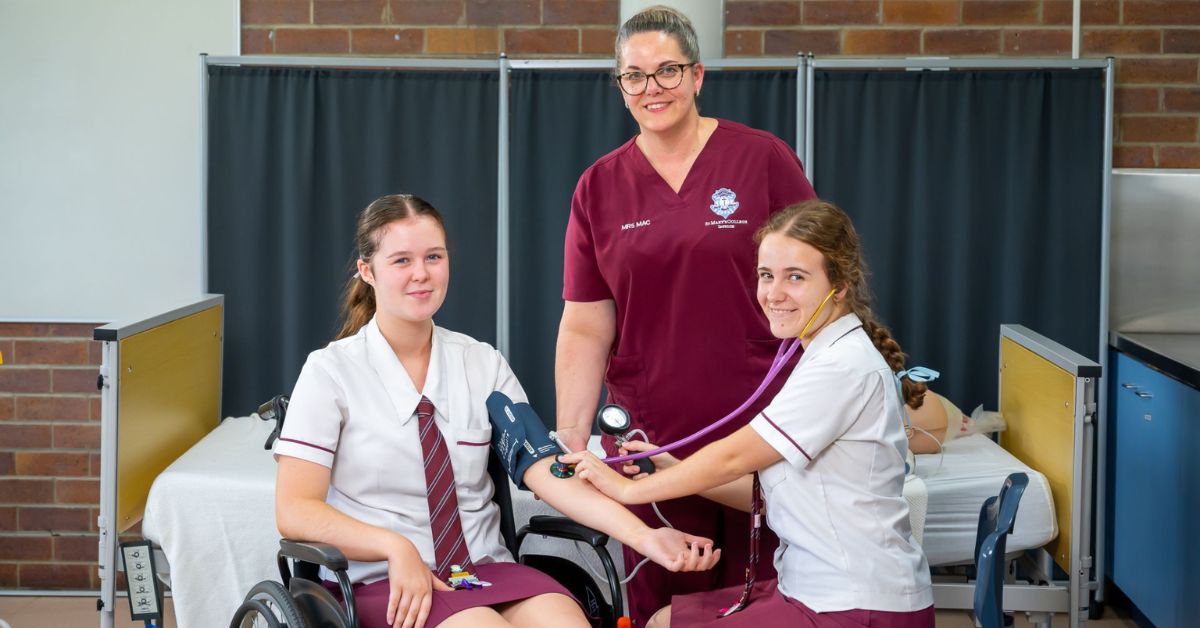
St Mary’s College in Ipswich is giving senior students a head start in healthcare before they finish Year 12, offering a specialised Assistant in Nursing certificate pathway found at very few other secondary schools in Queensland.
The programme, which sits within the school’s vocational education offerings, delivers Certificate II and III in Health Services alongside an Assistant in Nursing (AIN) specialisation delivered as a nationally recognised nano-qualification.
What sets it apart from the health certificates offered at other secondary schools is not just the content but the outcomes: graduates have moved directly into paid roles with West Moreton Health, St Andrew’s Hospital, Mater hospitals and residential aged-care facilities across the Ipswich region.
For families in Springfield Lakes and the broader south-west growth corridor, where demand for local healthcare workers continues to outpace supply, the programme represents a direct pipeline from classroom to workforce.
From nursing ward to classroom, and back again
The programme’s effectiveness starts with who teaches it. Melanie McAndrew, the school’s Program Leader for Studies, spent more than 20 years working as a nurse before moving into education. That clinical background is not incidental to the programme’s design. It shapes how the content is delivered, which industry connections get built, and how students understand the gap between theory and real working healthcare environments.
“It’s an incredible privilege to teach something like this,” McAndrew said. “I get to use my clinical experience, industry connections and passion for education to inspire the next generation of healthcare workers.”
She said the programme gave students both financial independence post-school and a clear pathway into further healthcare careers. “It’s a great opportunity for students to gain confidence, earn an income and kickstart their healthcare career pathway while helping meet local workforce demand,” she said.
The programme launched in 2023 and graduated its first cohort in 2024. In the roughly two years since, a number of those graduates have taken up roles locally, with employers drawn from both the public and private health systems as well as the aged care sector that is absorbing significant demand across the Ipswich region.
Skills that go well beyond what a textbook covers
The AIN nano-qualification sits above the standard certificate requirements and gives students additional clinical competencies that make them genuinely job-ready on graduation. The day-to-day learning at St Mary’s reflects that higher bar.

“Our Year 12 students might start their class by doing hand hygiene, taking observations, bandaging a snake bite, or practising CPR and defibrillation,” McAndrew said. “These are skills we practise every single day.”
Students also work through modules covering patient transport, dementia and delirium care, and other specialised clinical competencies that translate directly to the range of settings where AINs typically work. The programme builds practical muscle memory alongside theoretical knowledge, which is precisely what aged care and hospital employers look for when hiring entry-level clinical staff.
A clear-eyed reason to show up every day
For Year 12 student Addison Costello, the programme confirmed what she already suspected about herself.
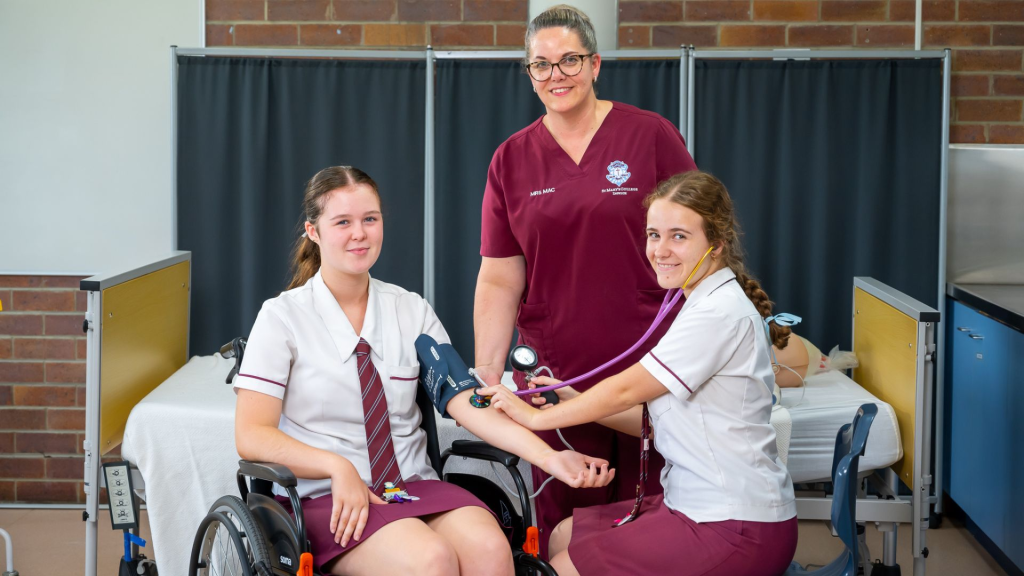
“I took up the certificate because I’ve always wanted to do something in the healthcare field,” Addison said. “I’m working towards a dual degree in paramedicine and nursing, and doing this qualification means I can get into a hospital environment earlier and gain more experience.”
The clarity that comes from working in a real clinical setting, even as a student, is something the programme delivers consistently. Addison described the sense of purpose it gave her cohort.
“I’ve always wanted to help people and be that person who can say, ‘you’re going to be okay, I’m here to help,'” she said. “I just want to make sure people are able to get the assistance they need.”
That sense of purpose matters beyond the individual student. Queensland’s healthcare workforce faces significant structural pressure over the next decade, particularly in aged care and community health settings, and programmes that produce work-ready graduates at 17 or 18 years old are an increasingly important part of how the system plans to fill that gap.
Finding out more
St Mary’s College is located in Ipswich and is part of the Brisbane Catholic Education system. Families interested in the health services programme can find further information here. The programme is open to students entering the senior years of secondary schooling.
Published 19-June-2026


