
Jabiru Spring Mountain OSHC at Spring Mountain State School to Close in September 2026 Amid Space Shortage

Out of School Hours Care services at Spring Mountain State School face closure in September 2026 after provider Jabiru Spring Mountain advised that a shortage of dedicated space on school grounds — a legal requirement for OSHC operations — has left the not-for-profit organisation unable to continue unless a workable solution is found before then.


The closure date, confirmed by affected families as September 2026 rather than end of year, has intensified concern across the Spring Mountain and Springfield Lakes community, where working families including single parents and dual-income households rely on before and after school care to bridge the gap between school hours and standard working hours. Spring Mountain State School gates open at 8:15am and school finishes at 2:30pm — a window of roughly six hours that is incompatible with full-time employment.

Why the Services Are at Risk

Jabiru Spring Mountain CEO Peter Loughnane and board member Sara Harrup confirmed the organisation wants to keep providing OSHC services at the school but is currently hamstrung by the limited space available. Under the National Quality Framework, providers must meet strict minimum space standards for every child in their care.

While schools are not legally required to provide a dedicated space for outside school hours care, any service that does operate must comply with these non-negotiable space requirements. This creates the current legal impasse: there is no mandate for a school to allocate additional rooms, yet a provider cannot legally open its doors if the available footprint falls short of the headcount.

The organisation has looked into local community facilities but found them either unavailable or financially out of reach for a not-for-profit. Using the school hall as a temporary fix is an option on the table, though families worry that regular external rentals and school events make it a shaky long-term solution. Ultimately, because there is no law forcing the host site to provide specific areas for care, the final call on space allocation sits with school leadership.

A Wider Problem Across the Springfield Corridor

The Spring Mountain closure is not an isolated case. Springfield Central State School has gone years without offering an OSHC service, leaving families to rely on nearby St Peter’s Lutheran College’s OSHC program. The demand has grown so high that St Peter’s can no longer accommodate Springfield Central students. Springfield State School also does not provide OSHC, an issue community members say they raised more than six years ago but remains unresolved.

The pattern across the Springfield corridor points to a systemic gap between the demand for OSHC services in one of south-east Queensland’s fastest-growing family suburbs and the supply of school-based care. Community members have noted that cleared land near some schools, including land unlikely to be developed following cancelled projects, may offer infrastructure opportunities that have not yet been fully explored. The Springfield Learning Coalition, which connects schools in the area, has been identified by community members as a potential vehicle for a coordinated solution across multiple schools.

What Jabiru Spring Mountain Currently Provides

Jabiru Spring Mountain delivers before school care, after school care and vacation care for students at Spring Mountain State School. The service provides a fully catered menu including breakfast, afternoon tea and a late snack on school days, and morning tea and lunch during vacation care. Families eligible for the Child Care Subsidy pay reduced fees based on combined household income. The programme has operated on the Spring Mountain State School campus since the school opened in 2019.

Families face fewer childcare options after Jabiru Spring Mountain OSHC confirms it will close in September 2026.
Photo Credit: Jabiru Spring Mountain

The service has already experienced one significant disruption, when it was forced to close temporarily due to staff departures following uncertainty over contract renewal. Families who lived through that closure say finding suitable alternatives in the area was extremely difficult, with limited options and high demand at existing services.

Why This Matters for Springfield Lakes and Spring Mountain Families

For single parents and dual-income households in Spring Mountain and Springfield Lakes, OSHC is not a discretionary service — it is the practical infrastructure that makes full-time work economically viable. With housing costs and basic living expenses requiring sustained full-time income, working only within the six-hour school day window is not a financially sustainable option for most families in the area.

The closure also falls hardest on those with the fewest alternatives: single parents without multigenerational household support, shift workers whose hours fall outside standard care windows, and families who cannot afford private nanny or babysitting arrangements. Community members have noted that in a cost-of-living environment where both parents are not just encouraged but financially required to work, the absence of mandatory OSHC provision at schools creates a structural disadvantage for families in growth corridors like Springfield and Spring Mountain where services lag behind population.

What Families Can Do

Affected families are encouraged to make their situations known directly, as individual representations carry weight in demonstrating the extent of community need and supporting efforts to find a workable solution before September 2026. Families can also contact Jabiru Spring Mountain directly at springmountain@jabiru.org.au or reach Jabiru’s central office on 07 3269 0044. Further information about Jabiru Community Services and its OSHC programmes is available at jabiru.org.au.


Published 11-March-2026.

Ed Sheeran Signs Ipswich Mural, Performs to Sold-out Crowds

Ed Sheeran made a surprise visit to Ipswich on Friday 20 February, quietly signing a mural of himself in the city’s CBD before heading to Suncorp Stadium for the first of three sold-out Brisbane concerts, capping a 10-month community campaign that put the Queensland city on the global map and generated an estimated $3 million in earned media value.


The visit delivered exactly what the residents of Ipswich had been working toward since May last year. The Get Ed to Ipswich campaign drew in local businesses, schools and residents, with a bakery producing Ginger-Ed cookies and the local pub pouring a custom Ed Beeran Brew among dozens of community-led activations. When Sheeran finally pulled up to the Hotel Commonwealth on Nicholas Street and uncapped a marker, the result of all that effort became real in about 30 seconds.

For Springfield Lakes and the broader Ipswich community, the moment landed as something beyond a celebrity sighting. It was a reminder that a city often overshadowed by its larger neighbour to the east can generate its own global story when its community commits to one.

Understanding the $3 Million Earned Media Impact

Earned media refers to publicity generated organically through news coverage, social sharing and third-party conversation rather than paid advertising. Unlike traditional marketing spend, it reflects independent coverage that audiences tend to perceive as more credible and authentic.

In Brisbane’s case, the campaign attracted state, national and international attention across broadcast, digital and print platforms, amplifying the city’s profile well beyond Queensland and creating exposure that would have cost significantly more if purchased as advertising space.

The Mural That Started It All

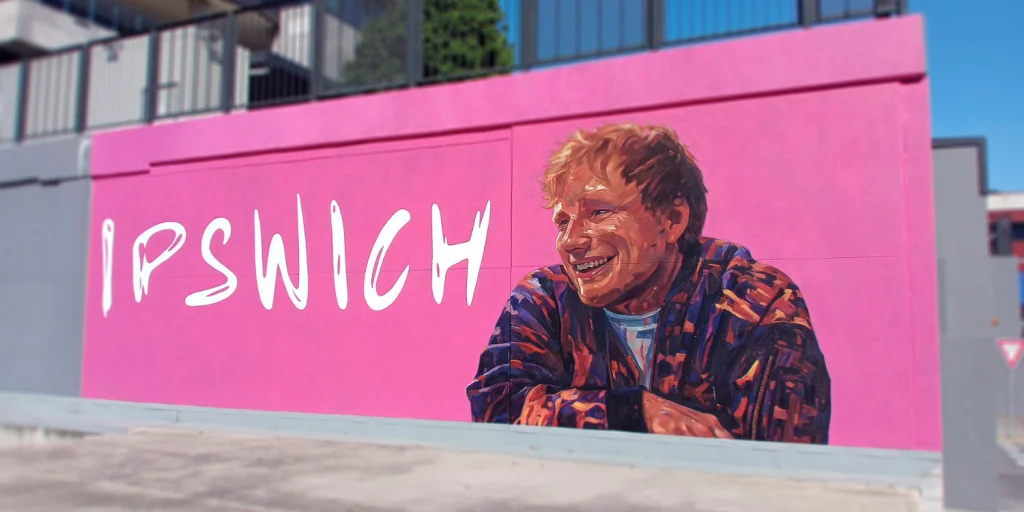
The campaign’s centrepiece was a large mural commissioned by Warner Music Australia and painted by Brisbane-based artist Duncan Mattocks between the Hotel Commonwealth and 1 Nicholas Street in Ipswich Central. Mattocks spent six days and approximately 10 litres of paint across 12 colours to bring the 11.5-metre by 4-metre artwork to life, with curious locals dropping by throughout the week to ask questions and photograph the work in progress.

The mural was commissioned in September 2025 to celebrate Sheeran’s eighth studio album PLAY, and quickly became the focal point of the community’s push to attract the star during his 2026 Australian Loop Tour. The connection between Ipswich, Queensland and Ipswich, England is not incidental. Ed Sheeran grew up in the Suffolk town and has a well-documented habit of visiting cities around the world that share his hometown’s name, including Ipswich in Massachusetts. The campaign in Queensland started in earnest after Sheeran’s record of visiting namesake cities was noted by a Brisbane radio host, who reached out to the Ipswich community last May.

Ed Sheeran mural
Photo Credit: Book An Artist

When Sheeran signed the mural on Friday afternoon, he wrote a message and quipped to those around him: “There’s a new mayor in town.” The remark set up what was to follow.

The Mayoral Chains and a Signed Jersey

At Sunday night’s final Brisbane concert at Suncorp Stadium, Ipswich’s community representative attended backstage and presented Ed Sheeran with the official mayoral chains of office, formally naming him honorary co-mayor of Ipswich. Sheeran wore them and later acknowledged the moment from the stage, telling the crowd that the Ipswich mayor had put the mayoral necklace on him before the gig and that he was now unsure whether he was technically a mayor.

As a parting gift, Ed Sheeran signed an Ipswich Town FC jersey, the English football club from his hometown, and addressed it to the “Mayor of the 2nd best Ipswich.” The community representative responded that she was more than happy to share the role, and that Sheeran was welcome back any time.

What the Visit Meant for Local Business

The mural on Nicholas Street became an immediate tourist magnet, with fans travelling from as far as Hervey Bay to photograph themselves in front of it after Ed Sheeran’s signature was confirmed. Local hospitality venues reported strong trade in the nights leading up to and during the Brisbane concert run, with dozens of businesses having participated in Ed-themed promotions and content throughout the campaign period.

The 10-month campaign is estimated to have generated around $3 million in earned media value through coverage across Australia and internationally, shining a sustained spotlight on Ipswich well beyond the weekend of the concerts. The economic ripple across Springfield Lakes, Ipswich Central and surrounding communities reflected what happens when a city backs itself.

Ed Sheeran’s Loop Tour continues with shows at Marvel Stadium in Melbourne on 26, 27 and 28 February, followed by a final Australian date at Adelaide Oval on 5 March. The signed mural at Nicholas Street, Ipswich Central remains open to visitors at all hours.


Published 26-February-2026.

Authorities Target E-Bike Rideouts in Springfield and Ripley

Authorities are ramping up enforcement against organised e-bike “rideouts” occurring weekly across South East Queensland. Officers are specifically targeting areas in Springfield and neighbouring Ripley, where they allege youth groups use social media to coordinate group rides on non-compliant, high-powered devices.


Chief Superintendent Mark Wheeler, from the Queensland Police Road Policing and Regional Support Command, confirmed that the service is allocating extra resources to Springfield, Ripley, North Lakes, Mango Hill, and the Gold Coast. Specialised teams now use digital intelligence to enact targeted responses to these gatherings.

Police allege that footage uploaded online shows groups using devices reaching speeds of 90 kilometres per hour, performing one-wheel stunts, and riding in large convoys through suburban streets.

Digital Monitoring and Police Strategy

QPS monitors these activities through its Digital Intelligence Coordination and Engagement (DICE) team. This unit tracks rideout announcements and helps coordinate the operational response. Online posts frequently discuss police patrol locations and offer tips on how to avoid interception.

Authorities describe these behaviours as posing a significant risk to the community. Officials emphasize that youth groups on e-devices are considered vulnerable road users who endanger themselves and the public when they disregard standard road rules.

Photo Credit: mPGC / Facebook

Safety Trends and Operation X-Ray Surety

Following 14 e-mobility fatalities across Queensland in 2025, authorities launched Operation X-Ray Surety. This statewide enforcement campaign ran from 3 November 2025 to 26 January 2026 to curb rising road trauma.

Between 3 November and 23 December, police issued 2,124 fines related to e-mobility devices. The most common offences included:

  • Failure to wear a helmet: 1,652 fines
  • Use of prohibited roads: 207 fines
  • Carrying passengers: 72 fines

Chief Supt Wheeler suggested that Christmas gift-giving likely increased the number of these devices on the road. He urged parents to ensure any e-bike they purchase complies with Queensland law, which requires motors to cut off at 25 kilometres per hour and limits power output to 250 watts.

North Lakes and Mango Hill Context

Springfield and Ripley Context

Springfield and Ripley sit within Ipswich’s rapidly developing Greater Springfield region, approximately 23 kilometres southwest of Brisbane CBD. The area’s master-planned communities include extensive cycling paths and recreational infrastructure that attract e-bike users, though illegal high-powered devices exceed specifications for safe use in shared spaces.

Springfield’s population has grown from approximately 5,000 in 2003 to over 70,000 across Greater Springfield suburbs including Springfield, Springfield Lakes, Springfield Central, Brookwater, and Augustine Heights. The rapid development created suburban street networks where youths organise group rides.

Ripley, located west of Springfield, underwent similar master-planned development through the early 2000s. The Centenary Highway extension to Ripley completed in 2008 improved connectivity whilst creating additional road infrastructure where non-compliant e-bike activity occurs.

Both suburbs contain substantial youth populations. The demographic profile contributes to e-bike adoption amongst teens seeking transport independence before obtaining driver licences.

Legal Requirements and Potential Penalties

Queensland law classifies any e-bike exceeding 250 watts or a 25 km/h assisted speed as a motor vehicle. Consequently, these devices require registration, insurance, and a valid motorcycle licence.

Riders of non-compliant devices face a ‘compliance package’ of fines that can exceed $1,600, covering registration, insurance, and licensing offences simultaneously.

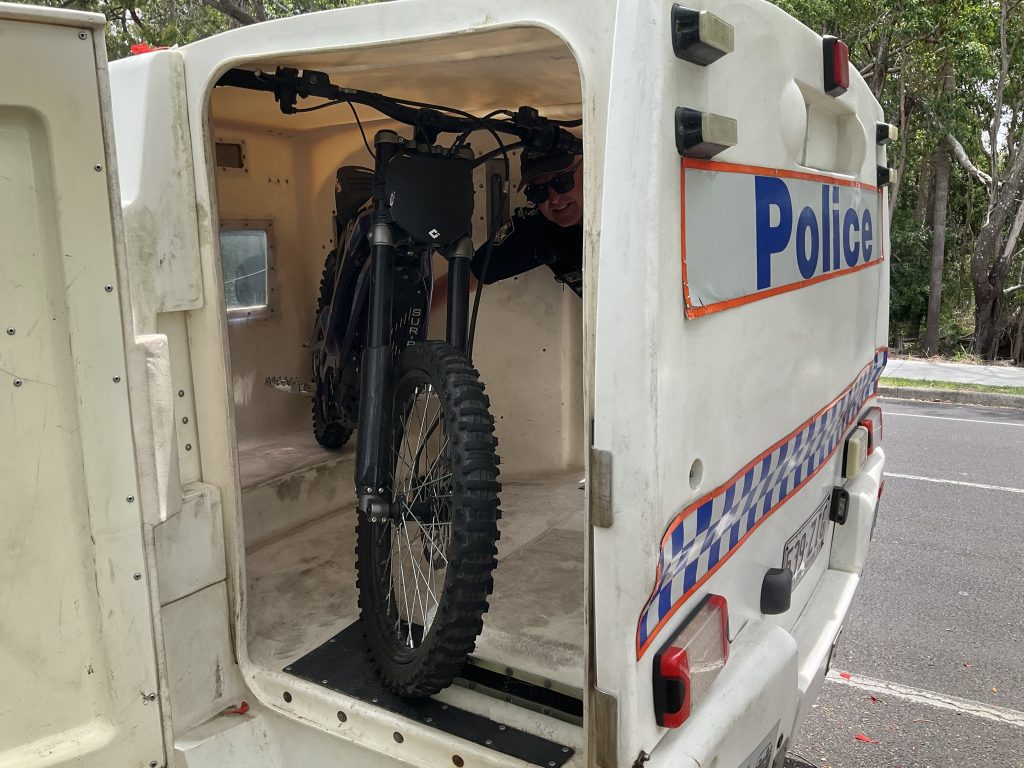
Police hold the authority to impound devices suspected of being involved in an offence. While owners can often go to court to seek the return of their property, a magistrate may order the permanent forfeiture or destruction of devices that are heavily modified or deemed a persistent public risk.

Community Views and Infrastructure

Community sentiment remains divided. While many residents express frustration with dangerous riding, others advocate for better infrastructure. Some community members suggest that the Brisbane 2032 Olympics provide an opportunity to build dedicated high-speed cycling networks that could safely accommodate evolving e-mobility technology.

Critics of the current crackdown argue that the speed capabilities of some modern devices—reaching up to 100 km/h—require them to be regulated as motorcycles rather than bicycles. Meanwhile, police continue to encourage residents to report dangerous behaviour or organised rideouts via Crime Stoppers.


Published 08-February-2026.