

World’s Fastest Teenager: Gout Gout Sets 19.67-Second 200m Record

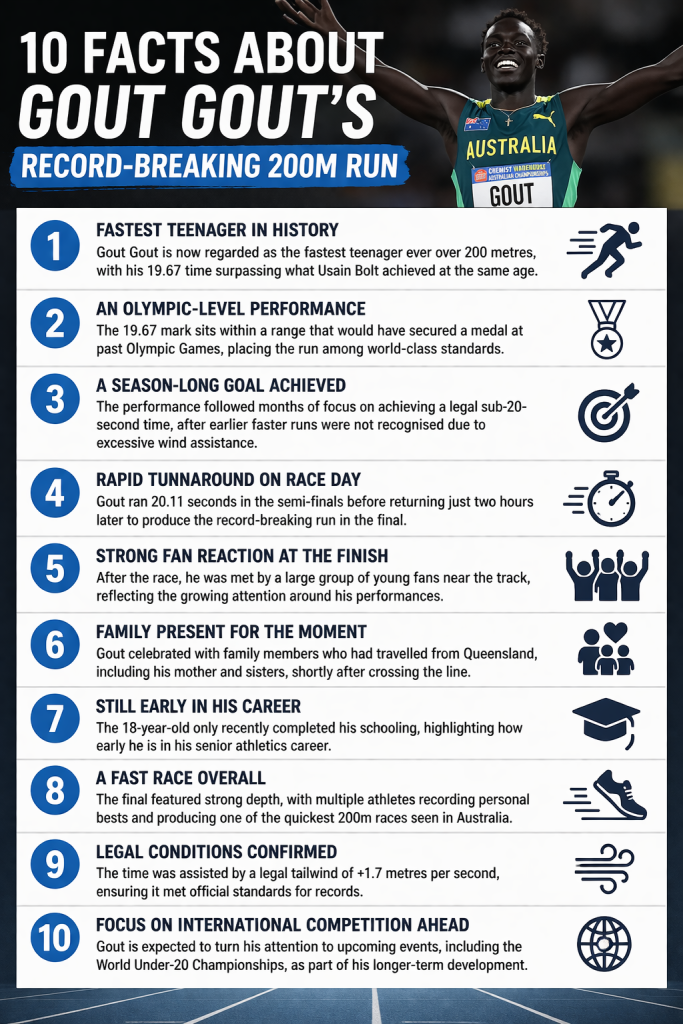
A new benchmark has been set in Australian sprinting, and it came from a teenager already carrying big expectations. Ipswich-born Gout Gout delivered a 19.67-second run in the men’s 200 metres at the Australian Athletics Championships, rewriting the national record and placing himself among the fastest young athletes the sport has seen.


The 18-year-old’s run marked the first time he has gone under 20 seconds with legal wind assistance, ensuring the result stands officially. The time places him among the fastest under-20 athletes in history, moving beyond what Usain Bolt achieved at the same age and behind only Erriyon Knighton in that category.

The performance has been widely framed as world-class, with the 19.67 mark sitting within a range that would have secured a medal at any Olympic Games in history.

Clear conditions follow months of setbacks

Gout’s record came after a period where conditions had repeatedly worked against him. Over the past year, several of his fastest runs had been assisted by wind beyond allowable limits or affected by cold and wet weather, preventing official recognition of sub-20 times.

On the morning of the final, clear skies and favourable conditions marked a change. Wind remained a key focus throughout the day, particularly after inconsistent readings in the semi-finals. When the final wind reading showed +1.7 metres per second, just under the legal limit, the result was confirmed.

The time also followed a structured build-up. Gout ran 20.11 seconds in the semi-finals before returning two hours later to produce the record-breaking performance.

A race shaped by pressure and pace

The final itself was not a one-sided contest. Aidan Murphy produced a career-best 19.88 seconds, challenging strongly through the bend and into the straight. At one stage, the pair were level, requiring Gout to respond late in the race.

His final stages proved decisive, with a strong finish over the closing metres separating him from the field. The race overall was notable for its depth, with multiple athletes recording personal bests.

The result reinforced the quality of the performance, with two athletes breaking the 20-second barrier in the same final.

Kennedy connection remains central

The championships had already drawn attention following the performance of Lachlan Kennedy, who won the 100 metres title in 9.96 seconds. His result made him the first Australian to break the 10-second barrier on home soil and set the tone for the weekend.

There had been expectations of a direct contest between Kennedy and Gout in the 200 metres, particularly after recent meetings between the pair. However, Kennedy withdrew on race day due to soreness following his 100m efforts.

Despite not competing, Kennedy remained part of the narrative. He had earlier communicated his support to Gout after withdrawing, and his performances across the championships contributed to the momentum surrounding Australian sprinting.


A performance built on intent and progression

Gout’s run followed a period of focused preparation, including a clear target to achieve a legal sub-20-second time. His progression has been steady in recent years, including breaking long-standing national marks as a junior and advancing to international competition, where he reached the semi-finals at the world championships.

The result is also notable given his stage of development. Having only recently completed his schooling, Gout remains early in his senior career while already producing times at the elite level.
Strong response from the crowd and the team

Following the race, Gout was met by a large group of spectators near the track, reflecting the level of interest in his performance. He later joined family members in the stands, including relatives who had travelled from Queensland to watch the event.

Members of his support team, including his coach and manager, were also present on the track shortly after the finish, as the result was confirmed.

Focus turns to international competition

With the national championships complete, attention now shifts to upcoming international events. Gout is expected to focus on the World Under-20 Championships as part of his development, rather than competing across all major meets.

His performance signals a shift in the country’s presence in the event. Alongside Kennedy’s 100m result, it points to a broader change in the depth and standard of men’s sprinting.

Published 13-April-2026

The Giant-Slayer in the Rain: Why Lachlan Kennedy is the No. 1 Australia Refuses to See

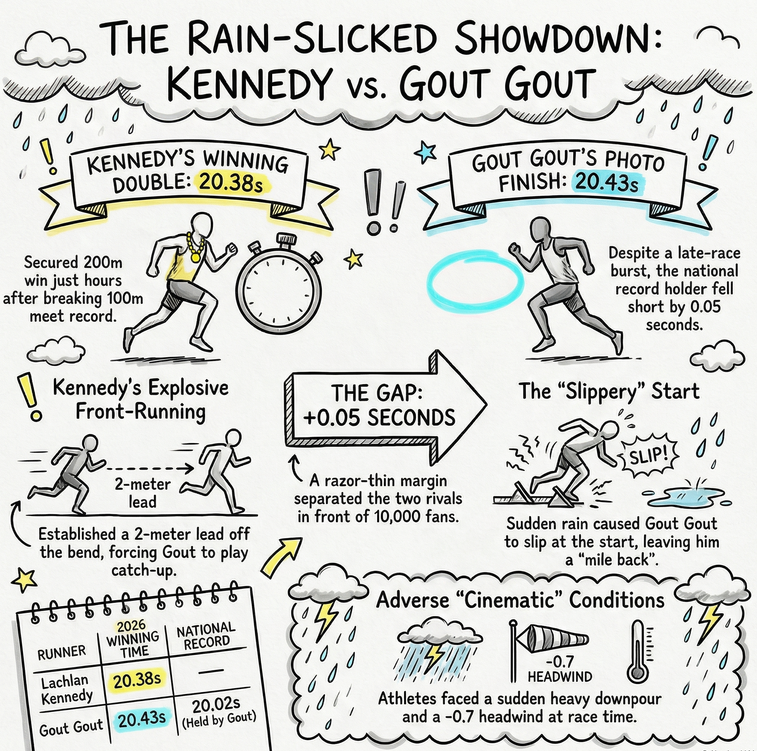
Gout Gout lost. All it took was 20.38 seconds.

For eighteen months, Australian athletics has revolved around Gout Gout — the teenage sensation driving headlines and expectation. But as the athletes walked out for the 200m at the 2026 Maurie Plant Meet, the narrative shifted with the weather.

In the rain at Lakeside Stadium, UQ 2025 Sportsman of the Year Lachlan Kennedy did it again — beating Gout Gout in the men’s 200 metres at the 2026 Maurie Plant Meet. Not on projection. On the track.

For a sport that has spent 18 months focused on one name, this result cuts through. Once might be an upset. Twice demands attention.

Here’s what actually decided it.

The Cinematic Clash in the Rain

After three hours of dry conditions, rain hit just as the field stepped onto the track — a moment Lachlan Kennedy later described as “cinematic”. It set the stage for a clear matchup: the 18-year-old national record holder against the 22-year-old Engineering and Commerce student at the University of Queensland who has built his career on stepping out of the shadows.

For Kennedy, it carried weight. A back injury ruled him out of the 2025 World Championships, and a false start ended his 200m national final last year. This wasn’t just another race — it was a chance to reset where he stands.

the rain-slicked showdown

The “Extra Man” in the Stands

The atmosphere at Lakeside Stadium was nothing short of extraordinary. A sell-out crowd of nearly 10,000 fans—many of whom braved the “sodden” conditions just to glimpse the Gout Gout phenomenon—created a pressurised cauldron of noise.

Kennedy, however, chose to absorb that pressure rather than be crushed by it. He viewed the massive turnout not as a distraction, but as a performance-enhancing “x-factor.” He characterised the energy of the crowd as an “extra man” on the track, fueling his drive to upstage the favorite.

“It’s unreal. The bar just gets raised for everyone else. You wouldn’t have all these people out here running if it was just one of us being super good… it’s so good for the sport and the spectators.”

Lachlan Kennedy

The Giant-Slayer: Kennedy Eclipsing Asafa Powell

Before the 200m showdown, Kennedy had already laid down a definitive marker. In the 100m earlier that evening—his first appearance over the distance this season—he delivered a performance of clinical power.

He stopped the clock at 10.03 seconds, a time that instantly recalibrated the expectations for Australian sprinting on home soil.

The victory was a historic scalp. By 0.01 seconds, Kennedy eclipsed the 18-year-old meet record held by the legendary Asafa Powell, whose 10.04 mark had stood since 2008.

It was a sophisticated statement of intent; while the public eye remained fixed on Gout’s potential, Kennedy was producing one of the fastest times ever recorded by an Australian in the present.

The Mental Game: “Not Panicking” Against the Slingshot

The technical mastery of Kennedy’s 200m victory can be traced back to the weight room. His explosive start is the product of a brutal training regime; observers note him “lifting something ridiculous in the gym, akin to a small bear, in weird leg weights.”

That strength translated into a two-meter lead off the bend, leaving Gout Gout—a notorious “fast-finisher”—with a massive deficit to erase.

Psychologically, Kennedy played a perfect hand. He understood the “familiar script” of the race: he would fly early, and Gout would attempt to slingshot off the curve in the final 50 meters.

The challenge was maintaining composure while hearing the inevitable footsteps of a closing rival. Kennedy’s victory was defined by his refusal to “freak out” when the gap began to shrink in the dying moments.

“It was just grit—another hard, gritty run—and I was able to get it done. The thing is you know Gout is going to come. It’s about not panicking, he will make up ground, but it’s knowing in your head that he is going to come and not freak out and stay relaxed.”

Lachlan Kennedy

Golden Toast: The Commercial Rise of Gout Gout

Even in defeat, Gout Gout remains a commercial juggernaut. Earlier in the meet, the teenager leaned into his status as a cultural icon, unveiling a “bizarre” piece of jewelry that signaled his arrival as a marketing force: a gold chain featuring a pendant of a partly eaten piece of Vegemite toast.

The bling was a direct nod to a high-profile sponsorship deal signed in early 2026, marking Gout’s transition from a mere prospect to the face of Australian athletics. There was a palpable irony in seeing the flamboyant accessory gleaming just moments before a “rocky” race on a rain-slicked track. It served as a reminder that Gout’s brand remains largely untouchable, even when his results face a stern reality check.

The Slippery Slope of 0.05 Seconds

The margin was 0.05 seconds — 20.38 to 20.43.

The environmental conditions of the 200m final turned the race into a battle of attrition. Between the heavy rain and a -0.7 headwind, the track became a liability. Gout suffered a critical slip at the start, a mishap that proved fatal in a race decided by fractions.

In those conditions, execution outweighed raw speed.

Gout’s slightly compromised start on the wet track mattered. From there, he was chasing.

Kennedy controlled the first half and created enough buffer to absorb the late surge.

The final scoreboard read 20.38 for Kennedy and 20.43 for Gout. While the 0.05-second margin was razor-thin, the technical “Paradox of Hierarchy” is more pronounced: Gout’s national record (20.02) remains a staggering 0.36 seconds faster than Kennedy’s winning time.

Gout, ever the professional, congratulated his Queensland teammate while acknowledging the “rocky” start that hampered his charge.

“Today, he had the ‘W’ but next time I’ll be better, for sure. He’s a Queensland guy and a good friend of mine, so congratulations to him. But I’ll be back, for sure.”

Gout Gout

A New Hierarchy in Australian Sprinting?

The 2026 Maurie Plant Meet has established a fascinating tension ahead of the National Championships in Sydney this April.

On paper, Gout Gout is the fastest man in history.

In practice, Lachlan Kennedy has now beaten him head-to-head for two consecutive years.

That doesn’t settle the rivalry. The next race in Sydney will matter more.

But it does clarify the present.

Right now, Kennedy isn’t chasing the conversation. He’s leading it.

It is the classic struggle between the record-breaker and the winner.

Published 29-March-2026

Ipswich Sprint Star Gout Gout Delivers State 200m Title Despite Flu Battle

Ipswich-born sprint sensation Gout Gout has added another title to his growing collection, taking out the open-age 200-metre crown at the Queensland Athletics Championships at QSAC in Nathan on Sunday, 15 March, and doing so while fighting off a bout of the flu that had left him flat on his back just two days earlier.


Read: Fast but Focused: How Athletics Australia Supports Gout Gout


Running into a -2.1 metres per second headwind, the 18-year-old stopped the clock at 20.42 seconds to hold off Tigers Athletics Club teammate Rory Easton, who pushed him hard to the line before falling short by a slender 0.09 of a second. 

It capped off a remarkable weekend for the young Queenslander, who had also risen from his sick bed on Saturday, 14 March to win the under-20 100-metre final, completing a championship double that few athletes in full health would find straightforward.

As recently as Friday, 13 March, Gout had been confined to bed. The symptoms were far from minor — congestion in his chest and throat, a runny nose, a cough. He had even been sleeping between races over the weekend just to keep his body ticking over. None of that was apparent when the starter’s gun fired.

After crossing the line, he let his celebration do the talking. He turned to a camera, pinched his nose shut with one hand, waggled his index finger with the other and shook his head, a cheeky, defiant moment from a young man who had just outrun both a headwind and a virus.

Speaking to the media, he described the gesture as a lighthearted acknowledgement that he could still get the job done even when his body was not cooperating.

He shared an embrace with his mother, Monica, after coming off the track.

Earlier on 15 March, Gout had moved smoothly through the semi-finals, posting 20.59 seconds with a +0.9 wind reading to advance as the quickest qualifier. The final, however, was a sterner test. Easton, 21, was not prepared to simply hand over the title, and for a moment the prospect of a genuine upset flickered into view. Gout steadied and held on.

Easton reflected on the experience with considerable generosity, telling the media that while a straightforward win would always have its appeal, competing against someone of Gout’s calibre was pushing him to performances he might not otherwise be reaching. He credited Gout with dragging him to times he was not sure he would be running otherwise.

Gout’s coach, Di Sheppard, told reporters after the race that Gout had shown real competitive grit, exactly the quality, she said, that would take him to the top.

Photo credit: Instagram/Gout Gout

The result was not about the clock, and Gout was the first to say so. His Australian and Oceanian record of 20.02, set in Ostrava last year, was never a realistic target on a windy afternoon in Nathan. Reflecting on the weekend, he told reporters the priority had always been securing the wins and getting valuable race time in his legs. More than that, he said the experience of competing while unwell had reinforced his belief in his own resilience, and that being able to perform under those conditions at state level gave him confidence for whatever challenges lay ahead, including, potentially, an Olympics.

It is not an idle ambition. Three weeks earlier at the same venue, during the Dane Bird-Smith Shield Meet, Gout clocked 10.00 seconds in the 100m, coming agonisingly close to becoming just the third Australian to run a legal sub-10-second time.


Read: History in the Making: Gout Gout and Ipswich Grammar


His main focus for 2026 is the World Junior Championships in Oregon in August, where he is targeting gold in the 200m. Before that, he will line up at the Maurie Plant Meet in Melbourne on 28 March, where Brisbane sprinter Lachlan Kennedy, who beat him in a tightly contested race at last year’s edition, looms as a potential rival once again.

For now, the priority is a simpler one: getting back to full health. Given what he just pulled off while ill, that can only be a worrying sign for the rest of the field.

Published 17-March-2026

Ipswich Sprinter Gout Gout Ends School Career With New 400m Mark

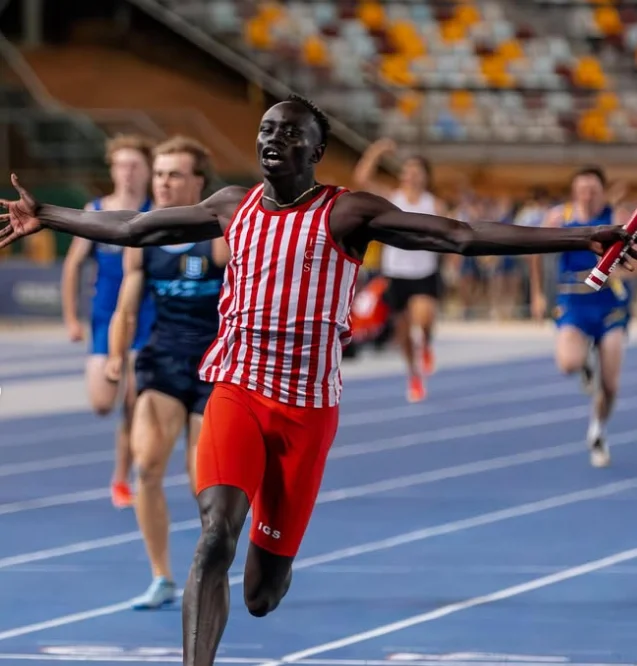
Ipswich sprinter Gout Gout capped his final school meet with a record 400m win for Ipswich Grammar School at the GPS Track and Field Championships in Brisbane.


Background And Athletic Progression

Gout Gout, a 17-year-old athlete from Ipswich, completed his final appearance for Ipswich Grammar School with a record performance at the GPS Championships on Friday, 24 October 2025. His junior career has included breaking national marks, winning major school titles, and progressing to international competition.

Over the past year, he set the Australian 200m record in December 2024 with a 20.04 run in Brisbane, later improving it to 20.02 in Ostrava in 2025. His strong season earned him a place at the 2025 World Athletics Championships in Tokyo, where he reached the semifinals of the 200m.

GPS Track and Field Championships
Photo Credit: Australian Athletics/Instagram

Record 400m Performance In Brisbane

At the GPS Track and Field Championships, Gout chose the 400m instead of his usual 200m event. He finished in 46.14 seconds, setting a new meet record and narrowly finishing ahead of Brisbane Grammar School’s Seth Kennedy, who also ran under the previous mark.

He then anchored Ipswich Grammar School’s 4x100m relay team, securing another win in a meet-record time of 41.30 seconds. The performance added to his history of multiple record-setting runs during his time in the school colours.

Gout Gout
Photo Credit: Australian Athletics/Instagram

Ipswich Grammar Connection

Gout has attended Ipswich Grammar School since Year 7, establishing himself as a leading figure in the school’s sprinting program. Across his school career, he set multiple GPS records and built a profile as one of the nation’s most promising young athletes.

Australian Athletics
Photo Credit: Australian Athletics/Instagram

Next Steps Beyond Ipswich

With his school athletics journey complete, Gout now turns his focus toward higher-level competition. His record-breaking year, national title, and World Championships campaign position him for continued progress on the international stage.

Outlook


Gout’s final GPS appearance closed a defining chapter of his career while reinforcing his status as a rising Australian sprinter. His achievements in Ipswich and beyond have set a strong foundation for his transition into full senior competition.

Published 4-Nov-2025

Brisbane Teen Gout Gout Breaks Records On Road To 2032 Olympics

Gout Gout, a 17-year-old sprinting sensation from Brisbane, has already clocked a 200m sprint in 20.02 seconds, breaking an Australian record and putting the world on notice ahead of the 2032 Olympic Games set to take place in his own backyard.


Local Hopes Rest On Rising Sprint Star

With the Brisbane Olympics still seven years away, Gout Gout is already turning heads across the country. The Ipswich Grammar student is drawing bold comparisons to Usain Bolt, not just for his blistering pace, but for the fearless confidence he brings to the track. 

Photo Credit: gout.goutt/instagram

His breakout win in the Czech Republic, where he outran seasoned international sprinters, sent a clear message: he’s not just fast for his age, he’s world-class. His meteoric rise has made him a thrilling symbol of Queensland’s future, and a name we’ll likely be chanting in 2032.

Queensland’s Magnificent Seven Shaping 2032 Dreams

Gout Gout is one of seven rising Queensland athletes with strong Olympic or Paralympic potential. The group includes runner Torrie Lewis, Australia’s fastest woman at just 20, and junior tennis world No. 1 Emerson Jones. Basketballer Rocco Zikarsky has signed with the NBA’s Minnesota Timberwolves, while young swimmer Koa Stotz and surfer Sierra Kerr are making waves in their respective sports. 

Photo Credit: gout.goutt/instagram

Holly Warn, Australia’s youngest Paralympian at the Paris Games, is a standout in para-swimming. All seven come from communities across southeast Queensland and are already gaining national or international attention.

Home Games Bring Focus To Local Athletes

The Brisbane 2032 Olympics have sparked fresh interest in young Queensland athletes with dreams of competing on home soil. His rise shows how local support and training are propelling talent to the world stage. Torrie Lewis has long spoken about the dream of running at home, while Zikarsky and Jones already bring international experience. 

Photo Credit: gout.goutt/instagram

Despite their different paths, all are focused on growth, juggling school, travel, and early career demands. What unites them is the chance to represent Queensland at Australia’s first home Olympics in over 30 years.

Community Connection And Future Goals

Each athlete has strong ties to their Queensland communities, with stories rooted in local pride, like Stotz training in Somerset and Warn finding purpose through swimming. For these young competitors, the 2032 Games represent more than a global event; it’s a daily goal. 


Hometown pride fuels their journey as they prepare for the chance to compete on home soil. And while the world will be watching, it’s southeast Queensland that will be cheering loudest.

Published 25-July-2025

Fast but Focused: How Athletics Australia Supports Gout Gout

Global athletics leaders and Australian officials are urging caution in managing the expectations surrounding Ipswich Grammar’s 16-year-old sprint phenom Gout Gout, even as the young star continues to break records and draw comparisons to Olympic legends.


Read: Industrial Action Threatens Waste Collection for Thousands in Ipswich


Managing great expectations

World Athletics president Sebastian Coe has emerged as a leading voice advocating for measured development of the teenage sprinter. “He is clearly talented, but there is a bit of realism here as well,” Coe emphasises. The former Olympic champion points to a sobering statistic: the majority of junior champions never successfully transition to senior competition.

“This is a rare and precious talent that will need nurturing and protecting,” Coe added.

Gout Gout’s path forward

Athletics Australia is actively working to shield their young star from excessive pressure. Jane Flemming, Athletics Australia President, underscores the need for the teenager to lead a normal life. “You can imagine at the moment he’s going to have every sporting code, every agent, every commercial entity, they’ll all be chasing him and he hasn’t even finished year 11,” Flemming tells Sydney radio station 2GB.

The national body’s strategy involves ensuring Gout can balance his athletic development with typical teenage experiences. Under the guidance of coach Di Sheppard, the focus remains on long-term development rather than immediate success. Flemming envisions a career path that could span multiple Olympic cycles, emphasising the importance of both physical and mental well-being.

The name debate

An additional aspect of Gout’s story is an ongoing dispute over his name’s pronunciation. While his manager, James Templeton, insists on “Gout Gout,” the athlete’s father, Bona, advocates for the pronunciation “Gwot.” The discrepancy stems from an Arabic translation error during the family’s migration process to Egypt—before the sprinter’s birth in Australia.


Read: History in the Making: Gout Gout and Ipswich Grammar


Despite the careful tempering of expectations, Gout’s achievements speak volumes. His recent 20.04-second performance in the 200m at the Australian All Schools Athletics Championships places him among the world’s elite junior sprinters.

As Athletics Australia works to protect and nurture this rare talent, the focus remains on ensuring the phenom reaches his 30s “in good physical and mental shape,” as Flemming puts it, potentially setting the stage for a long and successful career in international athletics.

Published 19-December-2024

History in the Making: Gout Gout and Ipswich Grammar

A star rises from Ipswich Grammar—faster than anyone could have imagined. Sixteen-year-old sprinter Gout Gout has made waves once more, both nationally and internationally.

His record-breaking performances in the All-Schools Athletics Championships have electrified the school, the community, and sports enthusiasts across the country.


Read: Springfield Lakes Sees Baby Boom as Birth Rates Surge and Families Flock In


A star is born

Born to South Sudanese parents, Monica and Bona, who moved to Australia in 2006, Gout has quickly become a name synonymous with speed and determination. From training at local Brisbane tracks to capturing national headlines, his journey has been meteoric. At just 16, Gout is not only breaking records but also proving that Ipswich Grammar is home to Australia’s next great athletic talent.

Gout shatters records in the All-Schools Athletics Championships

Gout’s rise reached new heights at the national All-Schools Athletics Championships in Queensland. Representing Ipswich Grammar, he ran an astonishing 10.04 seconds in the 100m heat. Though an illegal tailwind rendered the time unofficial, it signalled his raw potential. Gout didn’t disappoint in the final, clocking a legal 10.17 seconds—securing his place as one of the fastest under-18 sprinters in history.

The highlight of the championship, however, came in the 200m event. The teenage sensation smashed Peter Norman’s 56-year-old national record with a blistering time of 20.04 seconds. Norman’s record, set at the 1968 Mexico City Olympics, had stood as an untouchable benchmark for generations. Gout’s historic run cemented his status as Australia’s most exciting young sprinter.

For the Queenslander, the records are just the beginning. With ambitions to train with world-class sprinters like Noah Lyles under the guidance of coach Lance Brauman, he has his sights set on the global stage.

Gout credits much of his success to his coach, Diane Sheppard, who has been his mentor since he was discovered at Ipswich Grammar in Year 7. “She basically told me I could be great, and that was the first time anyone ever told me something like that,” he explained. “It’s been a fantastic relationship with Di since.”

About to turn 17 this December, his achievements aren’t just remarkable for his age—they’re globally competitive. His time of 20.04 seconds in the 200m makes him the second-fastest under-18 sprinter in history, trailing only U.S. star Erriyon Knighton. Beyond his lightning speed, his humility and dedication make him a role model for young athletes at Ipswich Grammar and beyond.


Read: Who is Gout Gout? Ipswich Grammar Teen Sprinter Takes Internet by Storm


“I’ve been chasing this national record for a while now,” Gout shared after his historic run. “In the heat, I thought I got it, but it was a crazy tailwind, so I just did the same thing and got the job done.”

“These are adult times and me, just a kid—I’m running them,” he said. “It’s going to be a great future for sure.”

Published 12-December-2024

Who is Gout Gout? Ipswich Grammar Teen Sprinter Takes Internet by Storm

As global attention shifts to the World Athletics Under-20 Championships in Lima, Peru, Ipswich Grammar School sprint sensation Gout Gout is rapidly becoming one of Australia’s brightest and most viral young athletes, with a natural running form and athleticism that reminds many people of a young Usain Bolt.

Read: Goodna Star Eithen Leard Set to Shine at 2024 Paris Paralympics

Early beginnings and rapid ascent

Born in Ipswich in 2007 to South Sudanese immigrant parents, Gout Gout’s journey in athletics began just a few short years ago. His talent was first spotted at an inter-house carnival at Ipswich Grammar School, where he impressed with his natural running form.

“Gout came to Ipswich Grammar as a full fee-paying student,” recalls coach Diane Sheppard. “I saw him run around and he got right up on his toes. He is a great kid from a great family.”

From these humble beginnings, Gout’s progress has been nothing short of remarkable. In the span of a few short years, he has transformed from an unknown in the athletics world to a record-breaking phenomenon, drawing international attention.

Coach Sheppard said this about him in 2022: “Six or eight months ago, he looked like one of those things that blow around in car yards. His arms were out of control.”

“I can go faster. There is always pressure, but I am just running,” the then-fourteen-year-old said.

Record-breaking teenage sensation

At age fourteen, Gout broke the Australian U16 record for the 100m with an impressive time of 10.57 seconds. A year later, he set a new Australian U18 record in the 200m with a time of 20.87 seconds, which he later improved to 20.69 seconds in January 2024.

In March 2024, he further solidified his status by clocking a blistering 10.29 seconds in the 100m at the Queensland Athletics Championships, matching the heat time of Olympian Rohan Browning at the Paris Games.

Given these record-breaking performances, it’s no surprise that comparisons with sprinting legends have begun.

Comparisons to Usain Bolt

Athletics Australia president and Olympian Jane Flemming was among the first to draw the parallel, noting similarities in their running style and early career trajectories.

Gout, for his part, takes the comparison in stride. “It’s pretty cool because Usain Bolt is arguably the greatest athlete of all time and just being compared to him is a great feeling,” he says.

“Obviously, I’m Gout Gout, so I’m trying to make a name for myself.”

A video of his lightning-fast race at the Queensland State Champs this year has gone viral this week. Admirers from around the world are drawn to his dominant talent and an iconic name that’s impossible to forget.

As he prepares for the World Athletics Under-20 Championships, expectations are high. Gout himself remains grounded, focusing on the joy of competition rather than the pressure of expectations. “It feels like this is where I’m meant to be,” he says.

“Running is pretty much my favourite thing to do. Just being out there versing everyone, versing faster people… pushing out of the blocks and everything about the track.”

Read: From Promise to Paralympics: Taymon Kenton-Smith Aims for Glory Beyond Paris

While the Lima championships represent Gout’s first major international competition, many in the athletics community are already looking further ahead. With the Paris Olympics now in the rearview mirror, Gout represents a bright hope for Australia’s sprinting future.

Published 25-August-2024